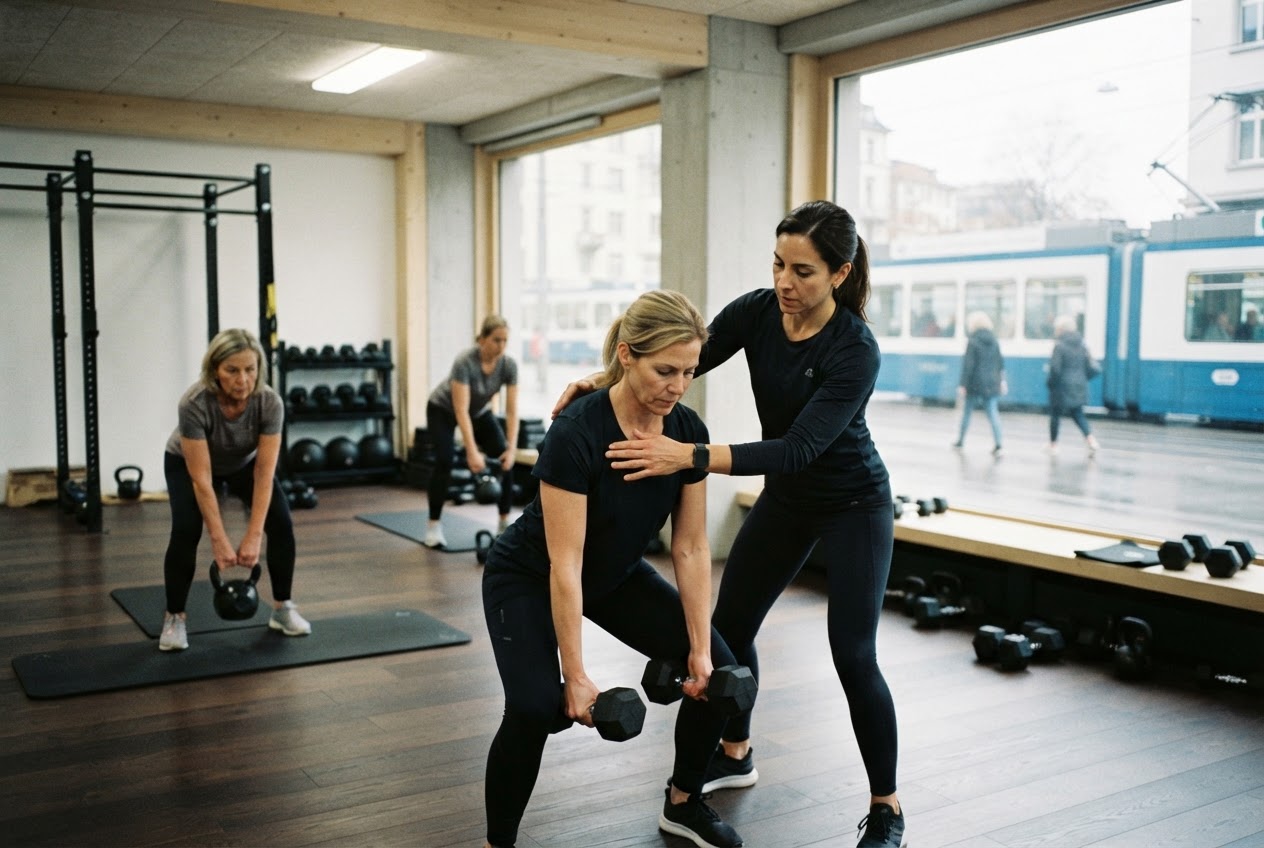
Which fitness club suits you during perimenopause? An overview of structured strength training, guidance, small-group formats and recovery to guide your choice.
Perimenopause is a phase of noticeable physical change, and choosing the right fitness centre matters more than most women expect. This text first tells you what is actually happening in your body — then translates every change into a concrete criterion for your club choice. By the end you know the clubs that meet these criteria on paper, the questions for your trial session, and your first training week.
Important up front: this text does not replace individual medical advice. If you have pre-existing conditions, pelvic floor complaints, osteoporosis risk or are on hormone therapy, clarify training and load with a doctor first.
The 30-second orientation
Three questions do most of the sorting:
- —Where are you today? Never trained, returning after a break, or experienced — the induction you need differs.
- —What bothers you most? Strength and bone loss, hot flashes and sleep, or pelvic floor — each theme leads to a different club profile.
- —How much guidance do you want? Self-directed with an induction, a small group, or one-to-one — the answer sets your budget and format.
Rule of thumb: this phase calls for heavy, progressive strength training twice a week plus a club that can absorb fluctuation. Everything else is an add-on.
What is really happening in this phase
Seven changes are documented — and each has a training consequence:
- —Muscle loss accelerates. As oestrogen falls, so does the muscle-building response. Progressive strength work is the documented countermeasure; the NSCA credits resistance training with countering menopause-related muscle loss in women aged 40 to 60.
- —Bone density starts to decline. From perimenopause onward, bone substance is lost, especially at the hip and spine. A review in the Journal of Mid-life Health shows two sessions a week at roughly 80 percent of maximum strength stimulate bone — the load is the stimulus, not the repetition count.
- —Body composition shifts. Fat mass moves towards the abdomen, even without weight gain. Strength plus daily movement counteracts this; endurance training alone does not.
- —Hot flashes and disturbed sleep strain recovery. Stanford Lifestyle Medicine sees more benefit for muscle composition from strength than from long endurance sessions in this phase — and poor nights shrink regeneration. Training must be allowed to get smaller in bad weeks, not disappear.
- —The pelvic floor becomes more vulnerable. Loss of resilience, urgency and pressure feelings increase in midlife. Heavy lifting and impact are manageable with an intact pelvic floor — with complaints, get assessed first. Physiotherapy on club premises becomes a selectable criterion.
- —Tendons and ligaments get more demanding. Collagen metabolism and oestrogen are linked: warming up and clean technique matter more, not less.
- —Menopause itself is not an endpoint. Supervised heavy programmes (the LIFTMOR trial series) improved bone density and strength even in women with already low bone mass — step by step, supervised.
What this means for your club choice
Each change translates into a checkable criterion:
- —Muscle loss → the club must allow and teach progressively heavy training: racks, heavy machines, a technique check.
- —Bone → a machine park that supports progressive loading, not only a class studio.
- —Hot flashes → air-conditioned rooms, a pool or showers for cooling down.
- —Pelvic floor → physiotherapy or pelvic floor competence on site.
- —Fluctuating weeks → monthly cancellation or the ability to pause.
- —Tendons and technique → proper induction support, not a pure self-service gym.
The reality check: what none of the 139 clubs documents
We checked our database (as of 22 October 2026) for women's health programmes: not a single one of the 139 clubs documents a menopause programme, cycle-based training or a small supervised strength format on its website. That does not mean good coaching does not exist — it means you will not find a line on any website that does the checking for you. Your check happens at the front desk, and there is a script for it below.
What is documented: 14 of 139 clubs verifiably have physiotherapy on site — the strongest checkable criterion for your phase. And with Kieser Training (Bern Monbijou, CHF 100 a month) the chain that publishes the very evidence for strength in menopause is in our database — machine-supported, taught, monthly cancellable.
Your four types — and what each costs
The returner: back after years away, wants a fresh start. Fits: a club with an induction and monthly cancellation, e.g. Luxor Fitness Zürich from CHF 89 or Kieser Bern from CHF 100.
The bone protector: osteoporosis in the family, wants a targeted stimulus. Fits: progressive machine training with coaching — Kieser Bern or a premium club with physio such as Holmes Place Lausanne from CHF 162.83.
The one with a pelvic floor history: complaints known, impact only after assessment. Fits: physio-led formats — the clinical reformer studios (4 to 8 people per class maximum) or a club with documented physio presence.
The quiet seeker: wants nothing to do with the evening rush, values discreet coaching. Fits: premium clubs with off-peak windows and calm wellness zones, such as Holmes Place Seepark Oberrieden from CHF 200.83.
The club recommendations: seven clubs that meet your criteria


Alongside the clubs: three clinical reformer studios in our database work physiotherapy-led with a maximum of 4 to 8 people per class — Pilates Physio Circle Zürich, Physio und Pilates Praxis für Bewegung Zürich, Swiss Pilates and Yoga Geneva. For a pelvic floor approach they are the gentlest door; prices on request. For the price side see our guide to gyms without an annual contract; for coaching options the personal training overview.
The price-per-session calculation
Your plan is twice a week. At 8 to 9 visits a month, each session costs: GYYM Basel about CHF 7.50, Luxor about CHF 9.90, Kieser about CHF 12.50, Holmes Place Lausanne about CHF 20, Seepark about CHF 25. For comparison: a supervised PT session costs a multiple of that (see the personal training overview). The calculation is not about the monthly price but the condition: only what you genuinely use twice a week is cheap — at any price. And some supplementary insurances contribute — read our health insurance guide before choosing a contract.
Four myths that should not slow you down
"Heavy training makes me bulky." The anabolic environment in perimenopause makes large muscle mass gains unlikely; what comes is tone and strength.
"Light weights with many repetitions are enough for bones." The bone stimulus follows the load — roughly 80 percent of maximum strength, twice a week.
"Cardio is enough." For muscle composition in this phase, the data favours strength over long endurance sessions; combining both beats dropping one.
"Starting is not worth it anymore." Supervised heavy programmes improved bone density and strength even with reduced bone mass. Later is not a reason — it is an argument for coaching.
Your first training week
Two strength sessions (30-40 minutes each): 6 to 8 exercises for the large muscle groups, 3 sets each, weight so the last 2 repetitions are hard. At least one rest day in between. One mobility or reformer session as you feel — pelvic floor work fits here well. No cardio obligation. Expectation frame: you feel strength within 8 to 12 weeks, the bone effect is a year's project — consistency pays, not overdoing it in good weeks.
The 6-question front desk script
- —"May I train progressively heavy — and what does the induction look like?"
- —"Do you have physiotherapy on site, or trainers with pelvic floor experience?"
- —"How cool are the studio and class rooms — is there a pool or showers to cool down?"
- —"Which training windows are the quietest?"
- —"Can I pause or freeze if my health takes a bad stretch?"
- —"What does the initial coaching cost and what is included?"
The answers say more than any website. Whoever dodges question 1 or 5 is out for your phase.
How vyvo helps you choose
We rate every club against the same criteria — price, contract terms, coaching and infrastructure — and document what is verifiable on provider sites. If you want to start without an annual contract, that guide lists the monthly cancellable clubs; our strength after 40 guide adds the perspective for everyone over 40, and the women's areas overview answers the question about dedicated zones. For your shortlist: use the Match Finder, do two trial sessions with the script above, then decide.