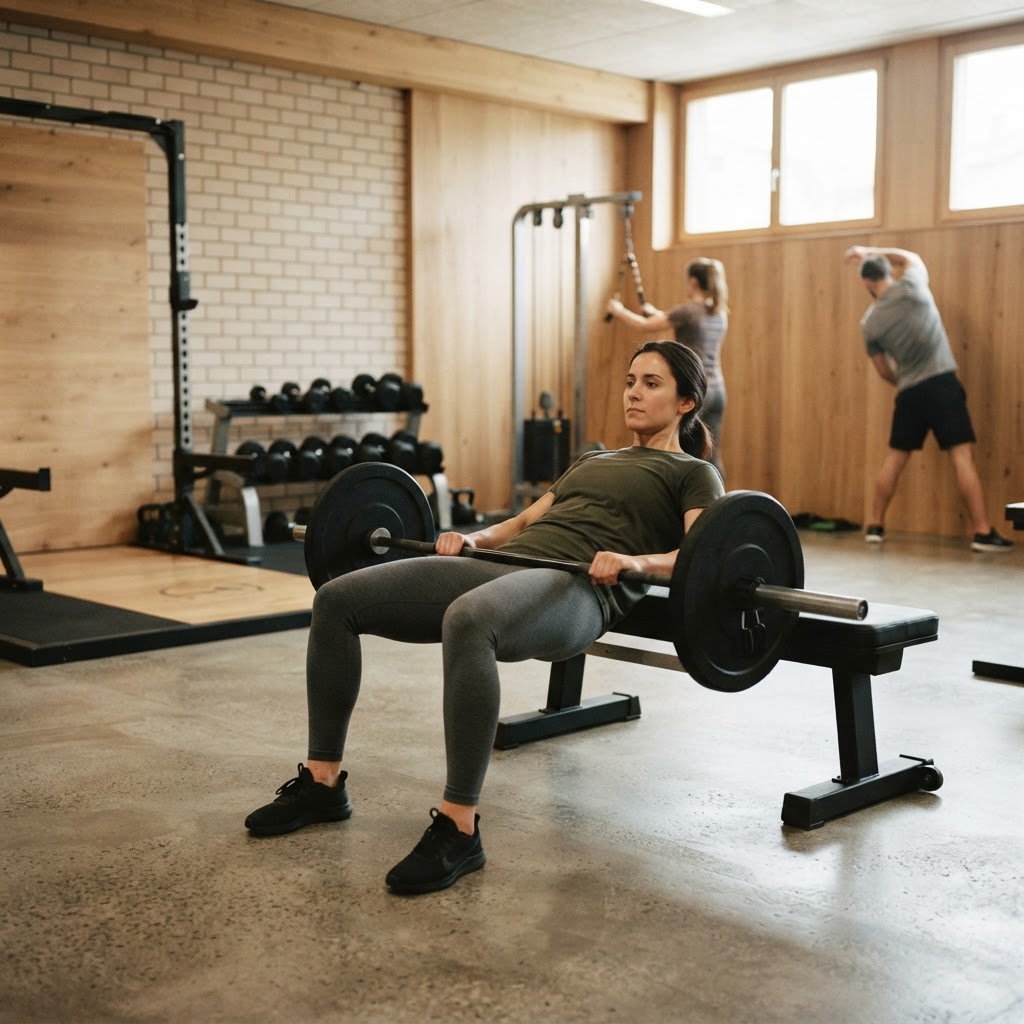
When you begin strength training or want to make it a firmer part of your daily routine, two questions often come up at the start: what does the training really deliver, and where do you feel comfortable while exercising. The two are connected, because an environment in which you enjoy training supports regularity over the long term.
This overview deliberately separates two levels. On one side is what research shows about strength training in women. On the other side are practical recommendations, for instance on the choice between a mixed centre and a centre with a women's area.
By the end, you should be able to decide which form of training suits your goals, what to look for in a centre in Zürich or Geneva, and when to seek professional advice.
What does research show about strength training in women?
Strength training is associated with measurable benefits for women across the different phases of life. Systematic reviews describe improvements in muscle strength, body composition and functional capacity, and this often already at a manageable training volume.
A randomised study in menopausal women showed that even a minimal training volume is linked to strength gains, without adverse effects on the cardiac autonomic regulation that was examined. That is good news for anyone starting with little time.
For women during and after menopause, studies suggest that targeted strength training, in part combined with loading stimuli for the bones, is associated with the preservation of muscle and bone mass. A meta-analysis additionally links regular strength training in postmenopausal women with a more favourable cardiovascular profile.
The context matters: these findings come from defined study populations. Individual responses vary, and what is optimal for one person need not be so for another. Personalisation and gradual progression remain central.
Why does strength training play such a large role right now?
Strength training is not a short-lived trend. The American College of Sports Medicine trend report for 2026 lists classic strength training as an ongoing central element of training planning. This aligns with the approach of several programme providers to make strength accessible at all levels.
For you this means one thing above all: in many Swiss cities you will find a broad, curated range of centres with well-equipped strength zones, class formats and guided onboarding. The choice is large enough to set priorities.
Instead of thinking about strength training only in terms of aesthetics, it is worth focusing on independence, metabolic health and everyday strength. This perspective carries over the long term, because it connects to concrete goals such as climbing stairs, lifting or maintaining stable balance.
When is a women's area suitable for you?
Some women enter strength zones with initial uncertainty, whether because of a lack of experience, the feeling of being watched, or practical questions about safety. A women's area or a women-only centre can offer a calmer environment here.
The evidence on such spaces is context-dependent, and effects depend strongly on the individual person. The practical logic is clear: when an environment lowers barriers, it supports regularity, and regularity is the actual driver of the effects described.
A women's area is therefore not a must, but an option. Anyone who feels comfortable in a mixed centre loses nothing. Anyone who feels safer in a protected setting and therefore exercises more consistently gains something.
When choosing, pay attention to the following points:
- —Is there a clearly separated women's area or only individual machines
- —Is a guided onboarding with technique checks available
- —Are the opening hours compatible with your daily routine, whether early or late
- —Are free weights and guided machines offered so that progression is possible
- —Does the class offering fit, for instance strength classes for different levels
- —Is there an offering with childcare where needed
How do you start safely and progress sensibly?
A safe start begins with clean technique, moderate load and a few, well-executed exercises. Short sessions are better than perfect plans that fail in daily life. Two to three sessions per week are a realistic framework.
Progressive overload means carefully increasing the demand over weeks, whether through more weight, more repetitions or a cleaner execution. What matters is that the increase suits your current level and not someone else's template.
A guided onboarding by professional staff lowers the risk of injury and increases safety. Personal training can help in the starting phase to consolidate movement patterns before you continue training on your own.
A few principles for the beginning:
- —Start with a few basic exercises and master them cleanly
- —Increase the load only once the technique sits stably
- —Plan for recovery, because strength also develops during the breaks
- —Document progress in order to make increases visible
A deeper perspective for midlife can be found in the article on strength training after 40, which further concretises the choice of a suitable centre.
When should you seek professional advice?
This overview does not replace medical advice. In the case of existing conditions or risk factors such as osteoporosis, high blood pressure or prior cardiovascular conditions, you should consult a qualified professional before starting or before a significant increase.
This also applies if you are unsure whether more intensive loading stimuli for your bones are sensible. Some findings come from specific phases such as peri- or early post-menopause and cannot be applied across the board to all women.
As a general rule: state your goals and possible limitations openly to the professional staff at the centre. In this way a programme can be designed that suits your body and your daily routine.
How does vyvo help with the choice in Zürich and Geneva?
vyvo is a Swiss comparison platform for premium fitness centres. Instead of searching through provider after provider yourself, you record your preferences, for instance a women's area, a strength zone with free weights or childcare. Find your perfect match.
The vyvo Score compares centres relative to their own city and category. It therefore does not average across the country, but provides a placement within the local environment. This makes the comparison within a city meaningful.
Here is how to proceed in practice:
- —Get an overview of the best fitness centres in Zürich or in Geneva
- —If childcare is important, specifically check centres with childcare in Zürich
- —Use the comparison to place offerings side by side
- —Determine whether a women's area is essential, desirable or dispensable for you
In this way a curated, compared selection emerges that suits your goals, rather than a random list.
Your concrete next steps
Keep in mind what the evidence supports and what is a recommendation. Supported is the benefit of regular strength training for strength, body composition and, in the groups studied, for bone and cardiovascular markers. A recommendation is to choose an environment in which you exercise consistently.
Decide first about the environment: mixed centre or women's area. Then set two to three fixed training times per week and start with a few, cleanly executed basic exercises.
If you have pre-existing conditions, seek professional advice in advance. Then compare the available centres in your city and let suitable providers contact you. In this way an intention becomes a plan that holds. fitness. decided.