
The instrument everyone trusts, and no one examines
For most of the last decade, the star rating has quietly become the way people choose a gym. Not the tour. Not the trial. The average, glanced at on a phone, before anyone walks through the door.
The habit is well founded. In its 2023 Power of Reviews survey, PowerReviews found that consumers now trust ratings and reviews as much as, and often more than, a recommendation from family or friends [1]. BrightLocal's consumer research puts the reflex in numbers: 82% of people read online reviews for local businesses, and the average reader consults around ten before feeling able to decide [2]. The review has moved from a nice-to-have signal to the first, and often only, thing a buyer consults.
But the instrument has a flaw that the industry has already documented on itself. A 2026 study in Frontiers in Sports and Active Living found that fitness instructors systematically misjudge how their own members feel, consistently underestimating member satisfaction when asked to predict it [3]. The people running the clubs misread the people using them. If the operators cannot reliably read member sentiment, a single averaged number on a maps listing is unlikely to do better.
So we went underneath the average. We read the text.
What we did
vyvo collected 36,541 Google reviews of fitness, wellness and hotel-fitness facilities across Switzerland (vyvo Fitness Study 2026; full method below). Of those, 14,376 contained written text. The rest, a clear majority, were a star rating and nothing more. 60.5% of reviewers left a score and not a single word explaining it.
That silence is the first finding. The average that guides so many decisions is built, more often than not, on ratings their authors never justified. Among five-star reviews, 61% carried no text at all.
From the reviews that did say something, we separated the two ends. Every review rated one or two stars with text was read and classified: 1,659 after removing reviews that turned out not to be about a fitness facility at all. Against them, a random sample of 2,000 five-star reviews, of which 1,399 gave a substantive reason rather than a bare "Super" or "Top".
Each review was read and assigned to one or more of eighteen themes, but only where the reviewer was genuinely complaining about, or genuinely praising, that subject. A sauna mentioned as the one good thing in an angry review was not counted as a complaint about the sauna. This distinction matters more than it sounds, and it is where simpler methods go wrong.
The finding: two separate clubs
The subjects that generate complaints and the subjects that generate praise barely overlap. They divide along a single line, and it is not the line most operators would guess.
On one side sits the commercial layer: the contract, the billing, the sales process. On the other sits the club itself: the coaching, the classes, the atmosphere, the equipment. Members complain about the first and praise the second, and the two rarely trade places.
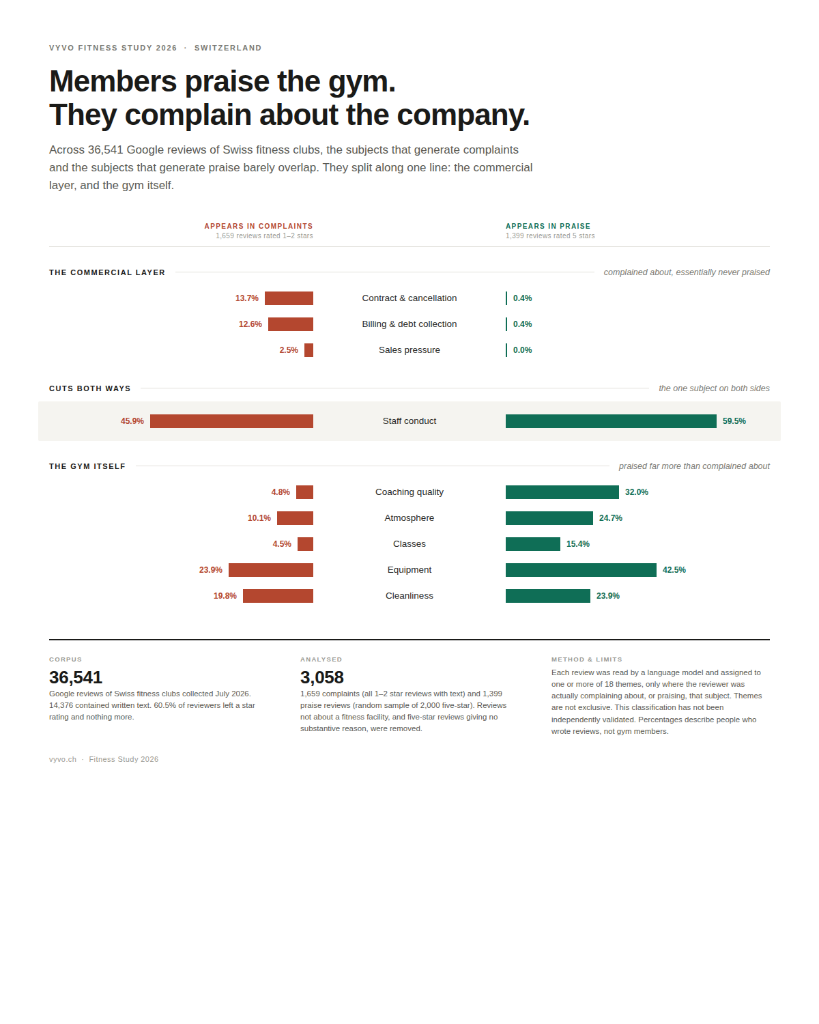
The commercial layer is complained about and almost never praised.
In this study, contract and cancellation appear in 13.7% of complaints and 0.4% of praise. Billing and debt collection, 12.6% against 0.4%. Sales pressure, 2.5% of complaints and, in all 1,399 substantive five-star reviews, zero. Not one person in the praise sample thanked a Swiss gym for how it handled their money.
The club itself is praised far more than it is complained about.
Coaching quality appears in 32.0% of praise and 4.8% of complaints, a ratio of roughly seven to one in favour. Atmosphere, 24.7% against 10.1%. Classes, 15.4% against 4.5%. Equipment and cleanliness sit closer together, praised somewhat more than complained about: 42.5% against 23.9% and 23.9% against 19.8%. The workout, the room, the people teaching it: this is what members write about when they are happy.
One subject cuts both ways. Staff conduct appears in 59.5% of praise and 45.9% of complaints. How the people behind the desk treat a member is the one thing that can define the experience in either direction. It is the exception that makes the pattern legible: if every subject fell neatly onto one side, the split would look too clean to trust. Staff conduct is the reminder that reviews are written by people having real, mixed experiences.
Why the average cannot tell you this
Hold the two lists side by side and the problem with a single score becomes obvious.
A club can have excellent coaching, a warm room, attentive staff, and a contract that is difficult to leave and a billing process that bites. A second club can have unremarkable coaching, a plain room, and terms that are clean and fair. Both can land on the same 4.4.
Both can land on the same 4.4. The star average cannot tell you which club is which.
The star average adds the two dimensions together and hands back one number. It cannot tell a prospective member which club is which. And the dimension it obscures, the commercial one, is precisely the dimension a new member cannot inspect from the outside. You can feel the atmosphere on a trial visit. You cannot feel the cancellation clause until you try to use it.
This is the structural reason the reviews underneath the stars matter, and the structural reason they are hard to use: the information that would protect a member is there, but it is buried in the one-star minority and averaged into invisibility.
You can feel the atmosphere on a trial visit. You cannot feel the cancellation clause until you try to use it.
What this means if you are choosing a club
Judge the two layers separately. They are not the same question, and no single rating answers both.
For the club itself, the reviews are reasonably reliable. Coaching, classes and atmosphere are praised specifically and often. If members consistently name a club's trainers or its floor, that signal is real.
For the commercial layer, the reviews will not help you until it is too late, because the people who write about contracts and billing are almost always the ones who have already been caught by them. Here the move is to ask directly, before signing: how does cancellation work, what triggers a renewal, what happens to the payment if you leave. The answers will not be in the star rating. They rarely are.
Members praise the gym. They complain about the company. Choosing well means reading both, and knowing which one the average is hiding.
Since a rating can mean two different things at once, what matters is knowing which one you are reading. That is the work vyvo does: on every club we list across Switzerland, we separate the two layers, so you can see how the club itself performs and what the commercial side is like before you commit, not after.
Method and limits
Source. Publicly posted Google reviews of fitness, wellness and hotel-fitness facilities in Switzerland, collected July 2026. 40,519 rows collected; 36,541 after removing duplicate and malformed rows. 14,376 contained written text.
Complaints. All reviews rated one or two stars with text were read and classified. Those not about a fitness facility (hotel restaurants, bars, reception desks) and those carrying positive text under a low rating were removed. A small number were lost to a technical fault in the classification pipeline. Final base: 1,659.
Praise. 10,551 reviews rated five stars contained text. A random sample of 2,000 was drawn with a fixed, reproducible seed. Reviews not about a fitness facility, and those giving no substantive reason, were removed. Final base: 1,399.
Classification. Each review was read by a large language model and assigned to one or more of eighteen themes, only where the reviewer was actually complaining about, or actually praising, that subject. A subject mentioned positively inside a negative review was not counted as a complaint, and the reverse.
Limits. This classification has not been independently validated by a second reader. Themes are not mutually exclusive; a single review may carry several, so percentages do not sum to 100. Every percentage describes the population of people who wrote reviews, which is not the population of gym members. The reviews cover more than 140 fitness, wellness and hotel-fitness locations across Switzerland's German, French and Italian regions. Nine clubs were truncated at 800 reviews by the collection process, so comparisons between individual clubs, and trends over time, are not supported and are not made here. No individual club, chain or city is named or ranked in this study.
Sources
[1] PowerReviews, The Ever-Growing Power of Reviews (2023). https://www.powerreviews.com/power-of-reviews-2023/
[2] BrightLocal, Local Consumer Review Survey, cited in "A Critical Assessment of Online vs Traditional Review Characteristics," arXiv:2111.04452. https://arxiv.org/pdf/2111.04452
[3] Frontiers in Sports and Active Living (2026), "Perceptions of instructor quality, loyalty and recommendation intentions in fitness centers." https://www.frontiersin.org/journals/sports-and-active-living/articles/10.3389/fspor.2026.1731975/full
[4] vyvo Fitness Study 2026. All complaint and praise percentages are from this study. Method and limits above.
Patrick Cuesta is the founder of vyvo, Switzerland's independent premium fitness decision engine. Before vyvo he was on the early team at Gymondo and spent fifteen years advising more than thirty companies across industries, fitness among them. He built vyvo on one conviction: a comparison system is only useful when it is completely independent, with no paid placements.