Thinking about fitness usually means thinking about the body. Strength, endurance, the number on the scale. That is understandable, but it falls short.
What gets measured is not the body alone. It is mood. Movement is one of the best-documented levers for how well we function day to day. And the happiness that follows is rarely a single moment. It is made of several parts that add up.
Part 1: movement, the measurable slice
In 2018, researchers from Yale and Oxford published the largest study of its kind to date in the journal «The Lancet Psychiatry». The dataset: 1.2 million people.
The result was clear. People who move regularly reported around 18 days of poor mental health per year. Among physically inactive people, that figure rose to about 53 days. A difference of 35 days.
A second finding deserves attention. The effect of team-based sport versus no exercise was roughly equivalent to the difference made by an annual income around 25 000 US dollars higher. Put another way, you would need to earn considerably more to reach the same effect through income that movement delivers directly.
One point of context. The study shows an association, not proof of cause and effect. It is a cross-sectional snapshot. Movement is linked to better wellbeing. That is not the same as saying it causes it. The association is nonetheless robust and consistent across a wide body of research.
Part 2: right rather than more
More is not better. The same study found a U-shaped curve. The benefit rises with movement, then reverses.
The most favourable range sat at three to five sessions per week, 30 to 60 minutes each. Beyond that, the effect declined. Training every day to exhaustion was associated with worse outcomes than a moderate, regular amount.
The takeaway is not «train harder». It is: find the right rhythm. And the right place to keep it.
Part 3: connection, the slice from Harvard
The Harvard Study of Adult Development is the longest-running happiness study in the world. It has followed people for more than 85 years.
Its central finding: the quality of our relationships is the single strongest predictor of long-term happiness and health. Stronger than wealth, stronger than intelligence, stronger than genes.
A club is not only equipment. The right one is an environment where you belong. That is part of why it matters not only that you train, but where.
Part 4: calm, the slice in your head
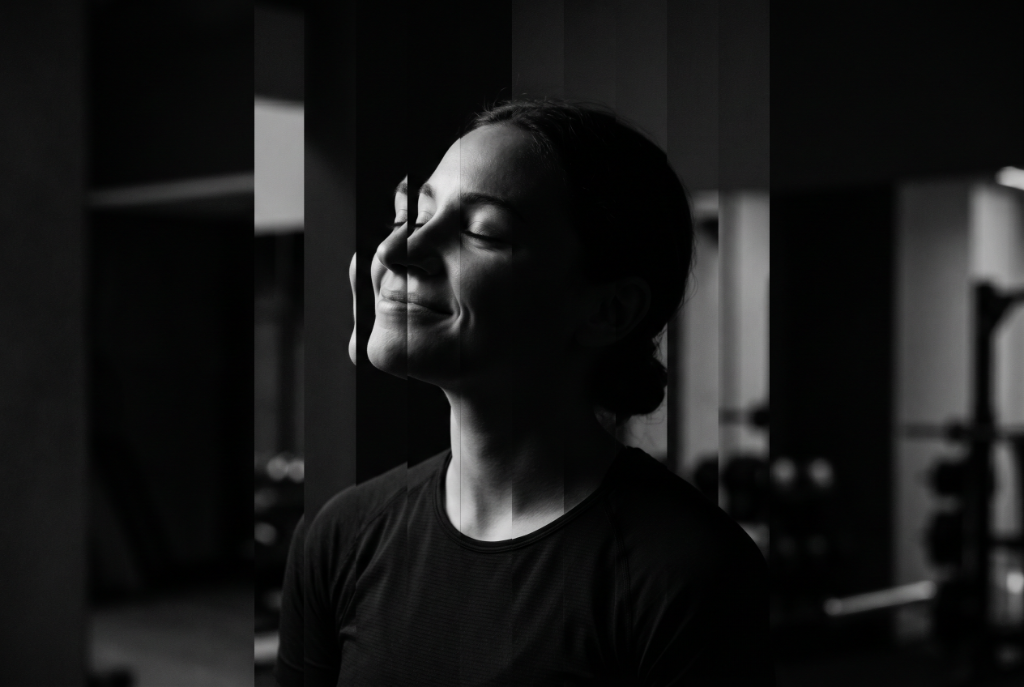
The moment after training. The breath settling. The quiet returning. The mind emptying for a moment.
This slice is the hardest to measure and the easiest to underrate. It is real all the same. The people who know it come back for it, long before any result shows on the scale.
Assembling the parts
Happiness has inputs you can choose. Movement is one. Connection is another. The right environment brings the two together.
The hard part is rarely the decision to train. The hard part is choosing where. That is exactly where vyvo begins.